

Our instruments
Six named instruments.
Designed to compress the upstream uncertainty that drives most cost and reputational risk in capital-intensive health investments, and to hold the project together afterwards.
Instruments across the capital cycle
From the earliest investment question to the last day of asset life.
Each instrument addresses a distinct decision moment. Each is a working digital tool as well as a method: it records evidence, computes a position and exports a document that a board, a commission or a credit committee can read. The instruments are deployed singly, or in sequence on projects that run from concept to financial close.
CASH
Capital Assets Solutions for Health
Designed for
Asset owners, operators and their financial sponsors
Structure
Six lifecycle stages
How is value protected once the capital has been committed?
CASH brings to the operating life of a hospital, a laboratory or a primary care network the analytical discipline that appraisal brings to the investment decision. It reads across six lifecycle stages and has been applied in more than ten countries, the most widely deployed of the six instruments.
Output
Asset register, lifecycle cost model, prioritised intervention scenarios and a phased investment roadmap
- 1Planning and programming
- 2Design and construction
- 3Commissioning and handover
- 4Operation and maintenance
- 5Renewal and adaptation
- 6Decommissioning
Six lifecycle stages, read as one sequence
VIBE
Viability, Identification of risks, Bankability, Engineering of overall project
Designed for
Funders, investors and grant-making bodies
Structure
Four areas, thirty-six criteria, 360 points
Is this project ready for capital, and on what conditions?
VIBE is taken before a feasibility study is commissioned. It scores a project across four weighted areas and records, for each criterion, the evidence required, the score awarded and an analytical summary. Classification thresholds are set at 55 per cent for conditional and 75 per cent for investment ready. The assessment is repeatable, so movement between rounds becomes the record of progress.
Output
Composite index, per-area classification, evidence trail, executive summary and recommendation
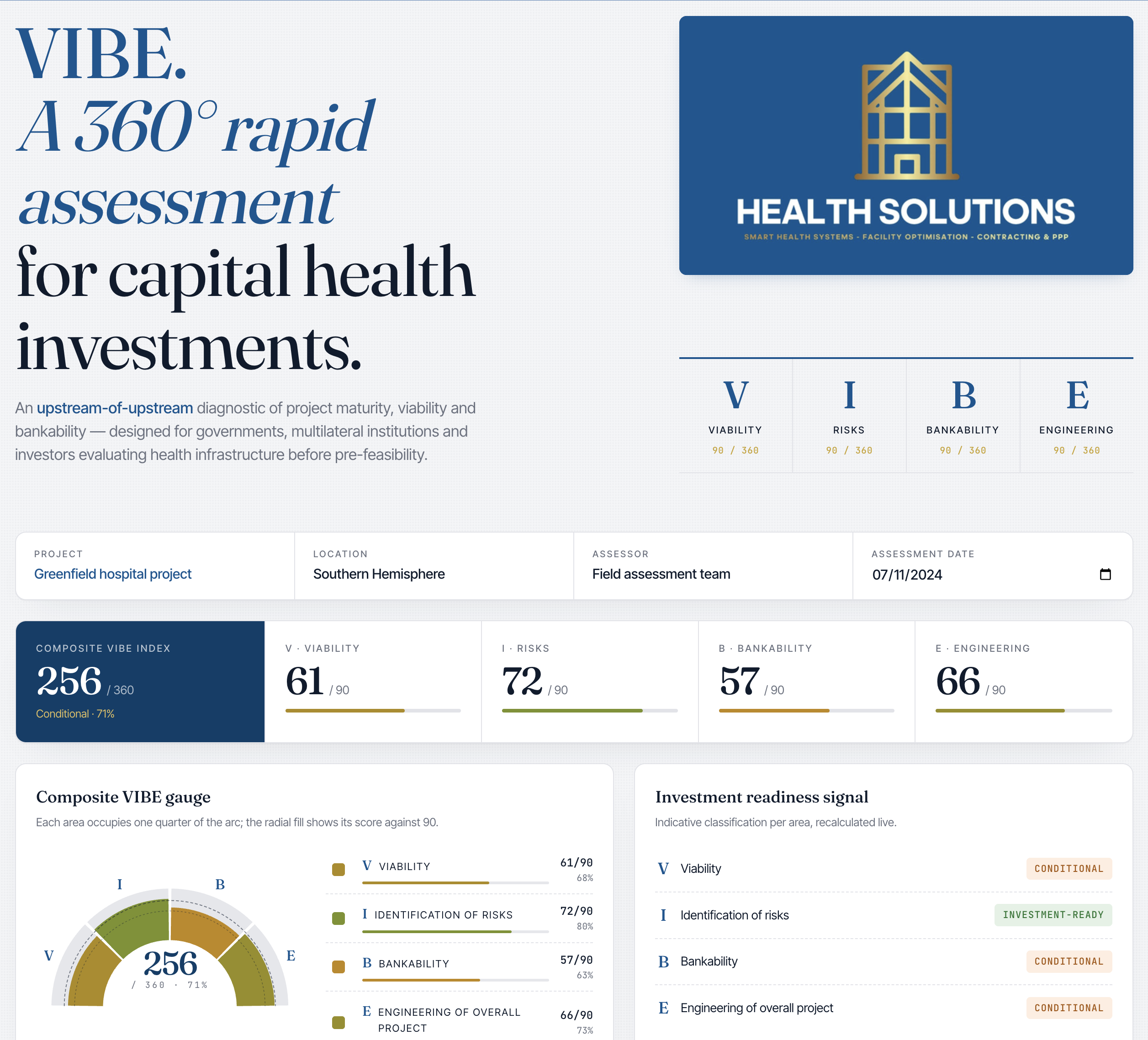
Synthesis: composite index and per-area scores
SCALE
Simplified Checklist for Assets Lifecycle Effectiveness
Designed for
Project owners, commissions and their technical advisers
Structure
4 phases, 25 components, 103 elements
What do the upstream phases still require?
SCALE sets out every component of the upstream phases, from pre-feasibility through feasibility and planning to design. Each element is recorded as started, in progress, finalised or not applicable, and progress is weighted. Two components act as gates: the clinical brief opens the strategic outline case, and construction readiness closes the upstream journey.
Output
Weighted completion by phase and overall, support flags and a dated readiness report
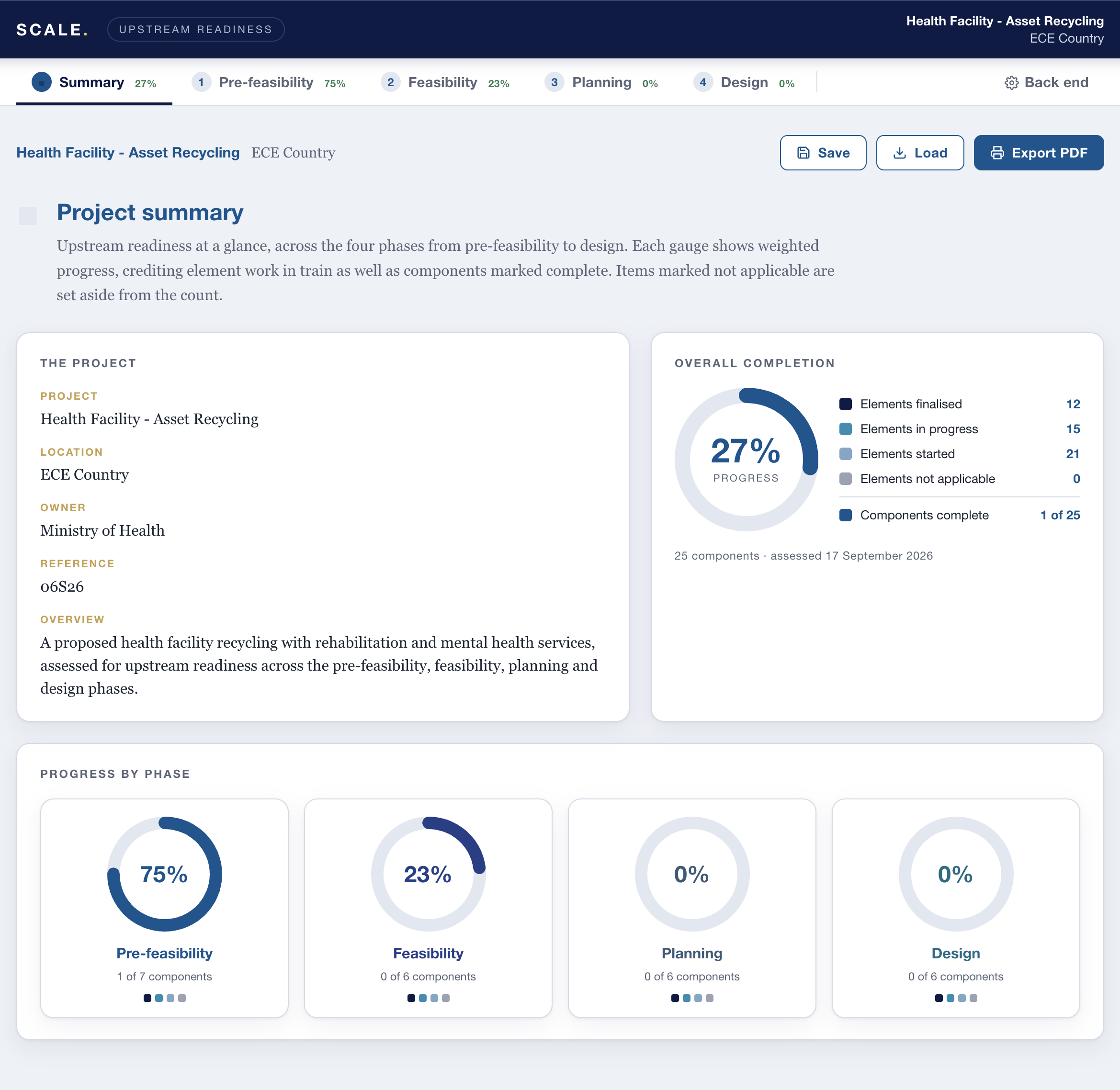
Summary: overall completion and progress by phase
VICI
Visualiser for Infrastructure and Capital Investment projects
Designed for
Sponsors, designers, cost consultants and funders
Languages
English and French, switched live
What must the facility contain, and what will it cost?
VICI holds the schedule of accommodation and turns it into the figures a funder asks for. Surface benchmarks draw on the OSCIMES and ANAP benchmarking system. Cost is assembled twice, by clinical function and by construction lot, and a plot coverage test reports whether the scheme fits the parcel.
Output
Schedule of accommodation, cost build-up, plot coverage test, PDF and CSV export
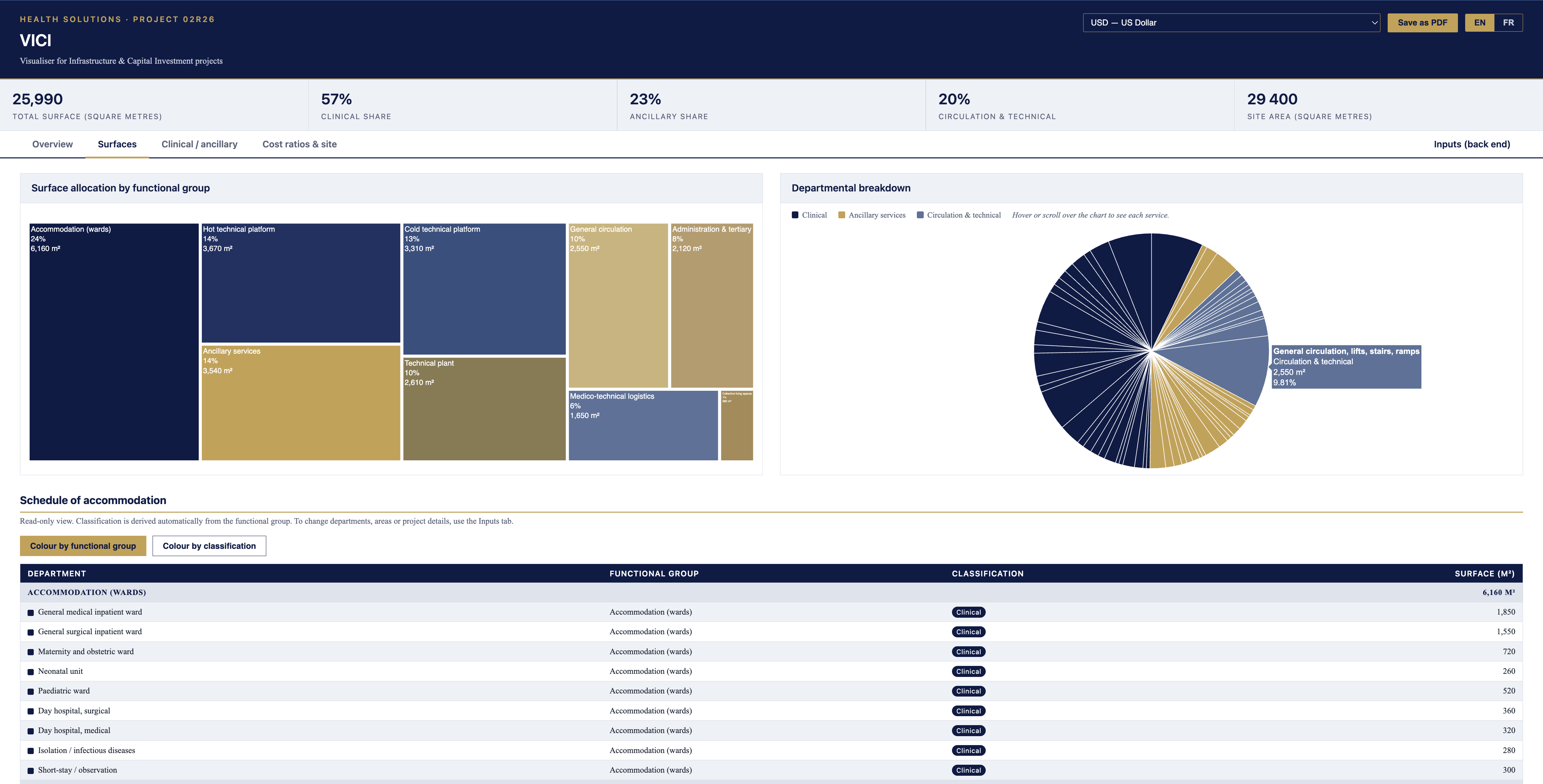
Surfaces: allocation by functional group and departmental breakdown
RAPID
Rapid Appraisal for Project Investment and Development
Designed for
Sponsors, investment committees and multilateral reviewers
Structure
Eleven components with a gap matrix
What has been appraised so far, and what remains open?
RAPID delivers a full upstream appraisal at a fraction of the cost of a feasibility study, and states plainly what it has not covered. Scope deferred to planning and design is excluded from the denominator, so the headline completion means what it says. A method note maps plain-language headings to the appraisal terminology used by development banks.
Output
Appraisal dashboard, gap matrix, risk register, resource mobilisation timeline and a typeset decision brief
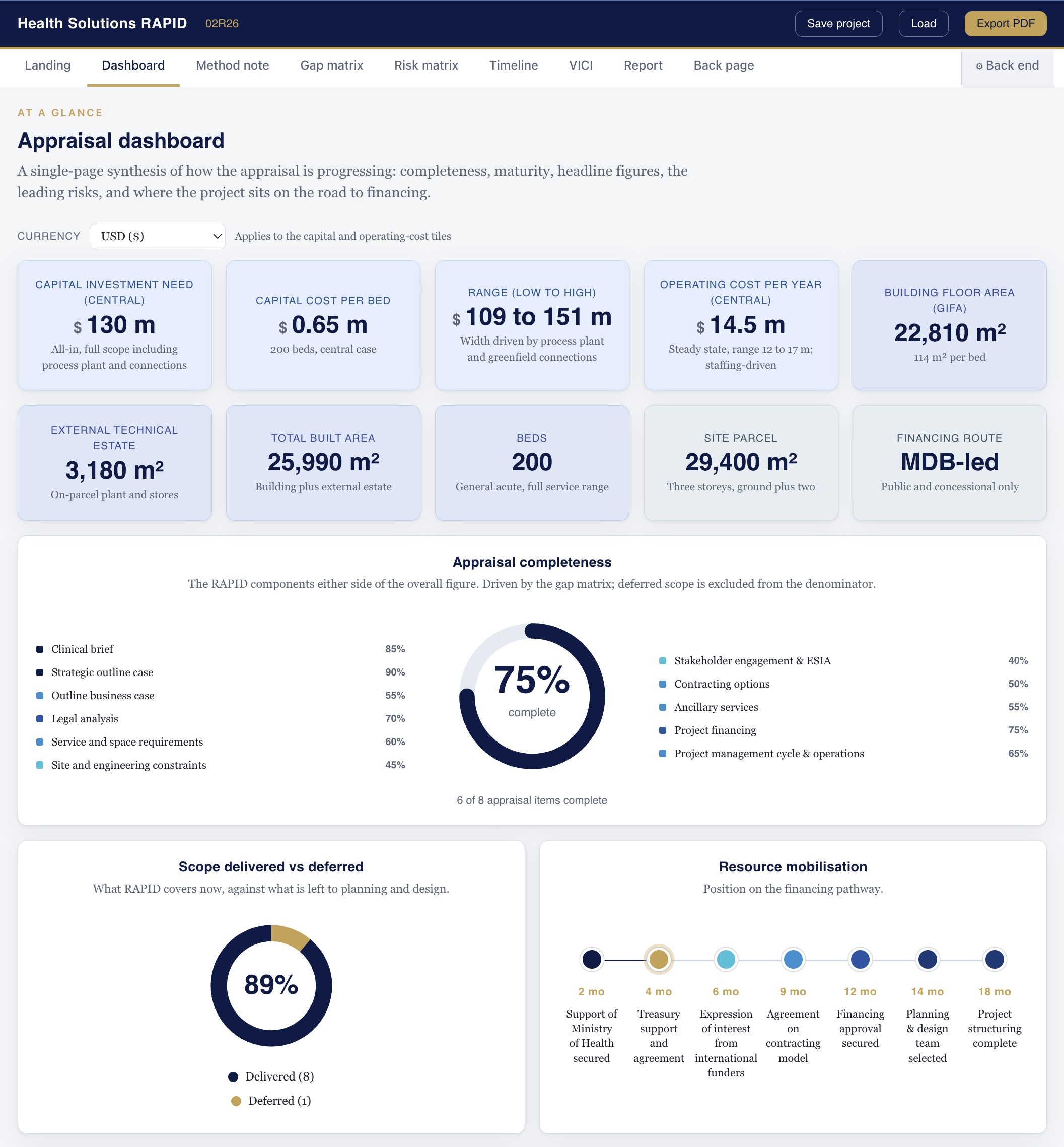
Appraisal dashboard: a single page synthesis
BRIDGE
Bridging Readiness, Investment Development and Government Engagement
Designed for
Governments, project commissions and their financing partners
Structure
Twelve work packages, four strands
How does an appraised project reach financial close?
BRIDGE carries a project from appraisal into planning and towards financial close. Twelve work packages run across four strands: support and secure, develop and strengthen, consult and prepare, bolster and sustain. Progress is read from the evidence recorded in each package and resolves to a named position on the roll-out.
Output
Roll-out dashboard, work package registers, document store and an exportable report
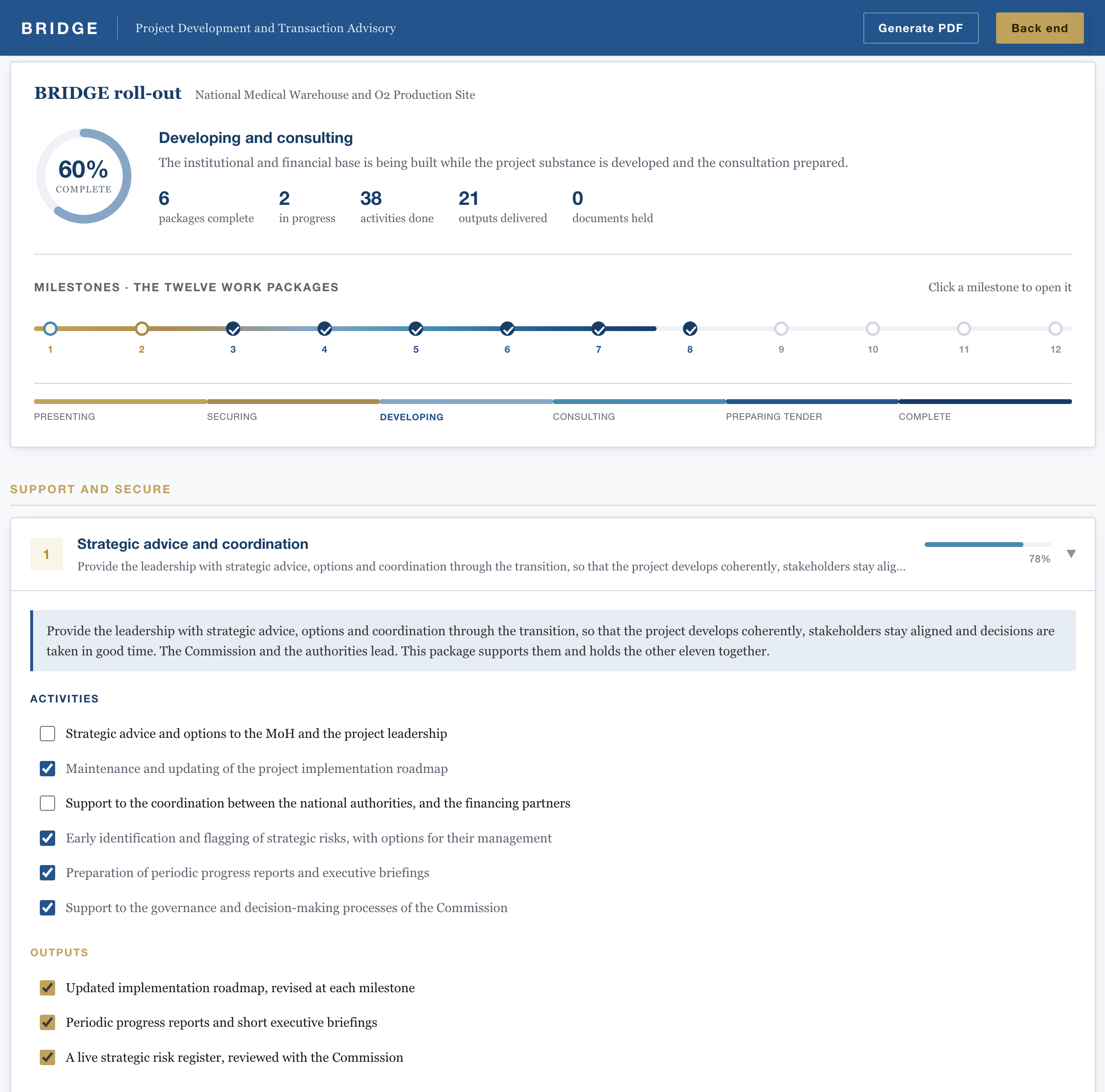
Roll-out dashboard: overall position and milestones
Where the instruments are used
Hosted in each client’s protected workspace.
The instruments are applied with each client inside a password-protected workspace on this site, opened for that engagement alone. The outputs are issued as PDF documents for circulation.