

Thriving PPPs
Forgive the tongue-in-cheek title. It borrows a phrase from British health policy of the 1990s, when complex contracting instruments were used to back the private investment programme known as the Private Finance Initiative (PFI), launched in 1992 by the Rt Hon Norman Lamont.
The then Chancellor of the Exchequer and MP for Kingston upon Thames wanted not only to attract private finance into public infrastructure projects, but also to commit private expertise to the performance of public assets through a fair allocation of risks and rewards. That, at least, was the spirit behind the soaring growth of the public-private partnership (PPP) models that have since taken the world by storm. When Labour came to power in 1997, the health minister Alan Milburn declared PFI “the only game in town” for new hospitals, and the phrase went down in the history of public law instruments as the epitome of political commitment to complex contracting as a means of closing the infrastructure gap.
Across the political spectrum, private sector participation in public activities such as the provision of health services is gaining ground, as public decision makers show increasing interest in skills that are not always available in the public sector: the design and construction of health infrastructure combined with its long-term operation and maintenance, for instance.
Engaging skilled private sector specialists and mobilising private finance for health may appeal to health stewards who know that, according to the SDG Health Price Tag, the global estimate developed by the World Health Organization and published in The Lancet Global Health in 2017, infrastructure is the second largest cost driver (34%) of the total needed to achieve the health targets of the Sustainable Development Goals.
Scoping PPPs: what are we talking about?
PPPs have been the new kid on the block since the mid-1990s, attracting growing interest and controversy. At the core of the concept lies a set of contracting instruments through which the public sector procures infrastructure, goods and services. PPPs are an overarching procurement model for engaging and working with private sector organisations, alongside traditional procurement routes. In short, in the definition used by the Canadian Council for Public-Private Partnerships, a PPP is:
“A cooperative venture between the public and private sectors, built on the expertise of each partner, that best meets clearly defined public needs through the appropriate allocation of resources, risks and rewards.”
PPPs are essentially complex contracting arrangements between the public and private sectors, under which private contractors provide an integrated stream of services. Unlike traditional procurement, which divides a project into separate phases, a PPP enables a group of private providers to deliver fully operational health infrastructure. From blueprint to sweating the assets over their lifecycle, the private providers offer health decision makers a single point of contact.
Health decision makers therefore buy a comprehensive set of services against a unitary charge tied to performance targets, in place of infrastructure and separate clinical or non-clinical services. The aim is to improve the quality and performance of health infrastructure and services while achieving value for money (VfM) across the lifecycle of the assets.
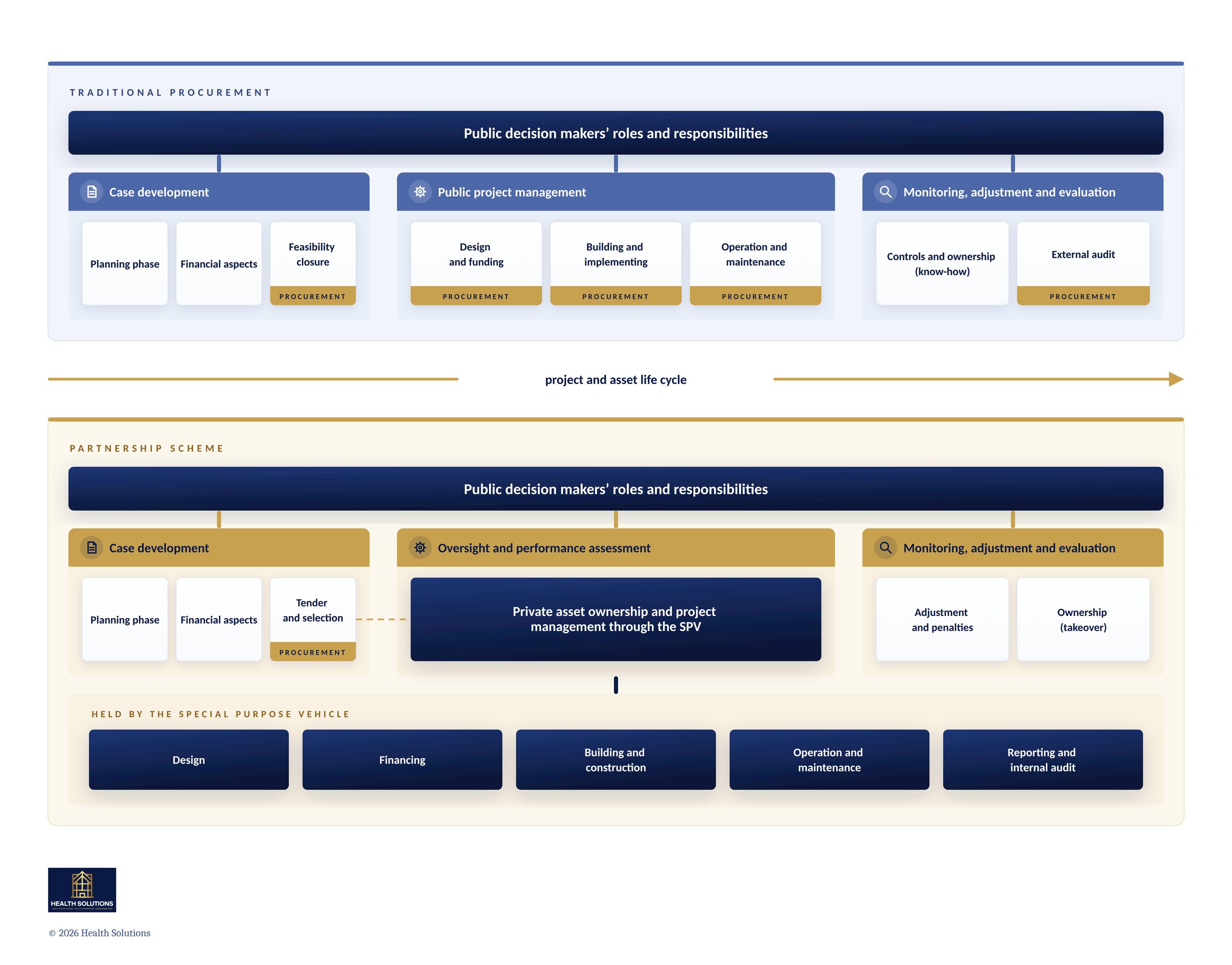
How does it work?
PPPs share a common set of characteristics.
Each risk is allocated to the partner with the greatest capacity to manage it.
The public sector buys a stream of services and does not acquire an asset. The value of the contract is assessed against the cash flow it generates.
Payment is made against measured and verified performance. This is how the risks borne by private partners become operational, since they face penalties if performance falls below par.
Depending on the form of PPP and the accounting rules that apply, part of the financing may stay off the public balance sheet. Where the private partner owns the asset, the public sector’s payments for services are recorded as expenditure. Not every form of PPP involves a privately owned asset, however.
Project finance is a common route to raising long-term debt for infrastructure PPPs. Equity arrangements (corporate structures) are possible but seldom seen in health.
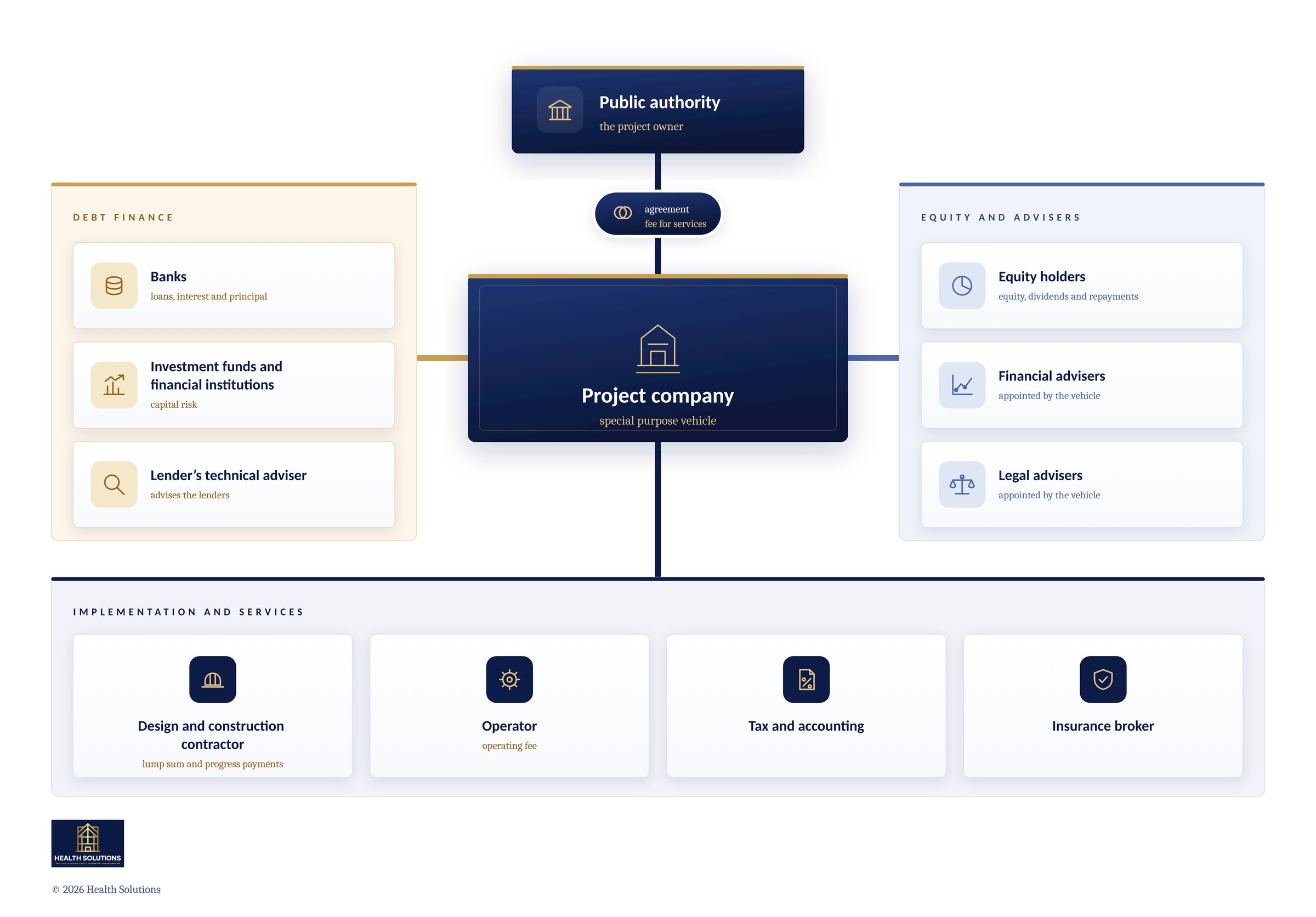
The most common health infrastructure PPP models cover contracting arrangements as varied as service contracts, management contracts, lease contracts, concessions, joint ventures and “alphabet soup” contracts named after the services provided, such as DBFOM (Design-Build-Finance-Operate-Maintain) or BOOT (Build-Own-Operate-Transfer).
Drivers of PPPs: what are health decision makers trying to achieve?
Health decision makers turn to PPPs first to improve service quality: through greater diversity of providers and contestability, through a focus on outcomes that brings in new perspectives and solutions, and through the involvement of citizens and civic groups in governance and monitoring. They also seek to get more from public assets over their lifecycle by drawing on private sector skills in management and infrastructure operation.
Output specifications and performance-based payments encourage innovation, in particular in response to design constraints or environmental standards. And then there is the budget: smoothing the flow of public spending… or keeping it off the books!
Among the hundreds of projects that PPPs allow health stewards to carry out, the most common range from replacing a building’s heating plant to comply with increasingly stringent environmental standards to procuring complete health facilities together with ancillary services such as catering, laundry, security of premises, shops and facility management, sterilisation and maintenance.
Success stories?
The blunt force trauma inflicted on UK taxpayers by the spectacular collapse of one of the main private PPP players, Carillion plc, which went into liquidation in January 2018, does not rule out empirical evidence of PPP success stories, including in the health sector. In a 2001 survey by the UK’s National Audit Office (NAO), 81% of public authorities rated the value for money of their PFI projects as satisfactory or better. In 2018 the NAO found that data on the benefits of private finance remained scarce, although departments reported higher maintenance standards under PFI. Later that year, the UK Government announced that it would no longer use PFI or its successor, PF2, for new projects.
The possibility of refinancing the contract, or of generating third-party revenue from the operation of the infrastructure, also helps secure the cost-effectiveness of some contracts.
The UK experience of DBFOM models under PFI shows both sides. Reported benefits include building costs reduced by 20% to 25%, tariffs around 10% lower than in state hospitals, quality comparable to public facilities, high performance on measures such as bed occupancy, quicker access and shorter waiting times, hospital design based on systemised care pathways, and high rates of investment in technology. Negative outcomes typically appear three to four years later: quality decay where contracts are not sustainably viable, cost spirals, unrealistic pricing designed to undercut public rates, contract trading, and a loss of public confidence that hardens opposition.
The Coxa Hospital for Joint Replacement in Tampere, Finland, offers a case of “outstanding performance”. A joint venture specialising in joint replacement, it was established in 2002 to serve a population previously covered by five hospitals, and operates as a publicly owned limited company bringing together public and private stakeholders at regional level. The Finnish Occupational Health Study (Work and Health of Finnish Staff) rated Coxa “outstanding” for workforce satisfaction, and STAKES, now part of the Finnish Institute for Health and Welfare (THL), rated it “exemplary for patient satisfaction”. Financial security has allowed price reductions and sustainable, self-financed capital development, while health outcomes have been positive. A case study published by the UK Government reports rates of infection and revision at about half the Finnish national average.
When should PPPs be avoided?
The most common mistakes in using PPP models, in particular in health, relate to three factors.
The cost of project finance. Capital for infrastructure raised on financial markets is more expensive than public debt.
Insufficient public capacity to manage large and complex contracts… and their potential shortcomings, including the failure of the private partner.
A choice of contracting solution driven by the ability to offset public debt or keep substantial investment off the books.
In their own words
The European Commission has warned that “there is the risk that the recourse to PPPs is increasingly motivated by the purpose of putting capital spending outside government budgets… It may happen that PPPs are carried out even when they are more costly than purely public investment.”
The World Bank, for its part, notes that “PPPs can be a powerful policy tool for improving the viability of public hospitals and the quality of their services.”
Mind the gap?
One of the key conditions of success for long-term contracting arrangements is the capacity of the public sector to grasp and manage the complexity of PPPs.
Any discussion with health policy makers committed to closing the infrastructure gap, or concerned with capital investment in health system preparedness, soon turns to PPPs. Complex contracting arrangements still carry an aura of solution, and the promise of better performance from health assets. Yet they are one option among several. Health system decision makers therefore need knowledgeable advisers, with sound legal capacity and a sector-specific understanding of public needs, who can give independent advice, compare contracting options and procurement routes, and tailor the solution best suited to each project. That is the commitment of Health Solutions.
Dr Gwen Dhaene